ORCHESTRATION & REVIEW
Clear ownership. Fresh review.
Bounded tasks and explicit handoffs keep implementation agents and independent reviewers aligned.
Shangru Li / Software Engineer
I build software with agents, using a complete development workflow that turns product ideas into verified releases.
ToolFlow is my shipped example: a native app built with that workflow.
Explore the workflow01 / AGENTIC DEVELOPMENT
I run a complete agentic software development lifecycle (SDLC) for my personal projects.
I set product direction and acceptance criteria. Agents coordinate execution and independent review. Physical-device QA and final App Store submission stay with me.
FROM REQUIREMENTS TO VERIFIED DELIVERY
Set requirements, acceptance criteria, and delivery scope.
Read the repository, map dependencies, and assign focused tasks.
Make scoped changes, add regression checks, and update docs.
Use an independent agent with fresh context. Resolve confirmed findings.
Run tests and native UI checks. Record remaining device QA.
Integrate reviewed changes and complete authorized delivery and release preparation.
ORCHESTRATION & REVIEW
Bounded tasks and explicit handoffs keep implementation agents and independent reviewers aligned.
CONTEXT & PROMPTS
I maintain instructions, task briefs, reusable skills, and architecture contracts that give agents useful context.
TOOLS & VERIFICATION
MCP-integrated tools connect coding agents to tests, simulator workflows, accessibility, and localization checks.
RELEASE & CONTROL
Agents prepare builds, metadata, and release documentation within the task's authorized scope.
02 / THE WORKFLOW IN PRACTICE
A native iPhone and iPad app that brings my product engineering and agentic development skills together.
NATIVE IOS & IPADOS APP
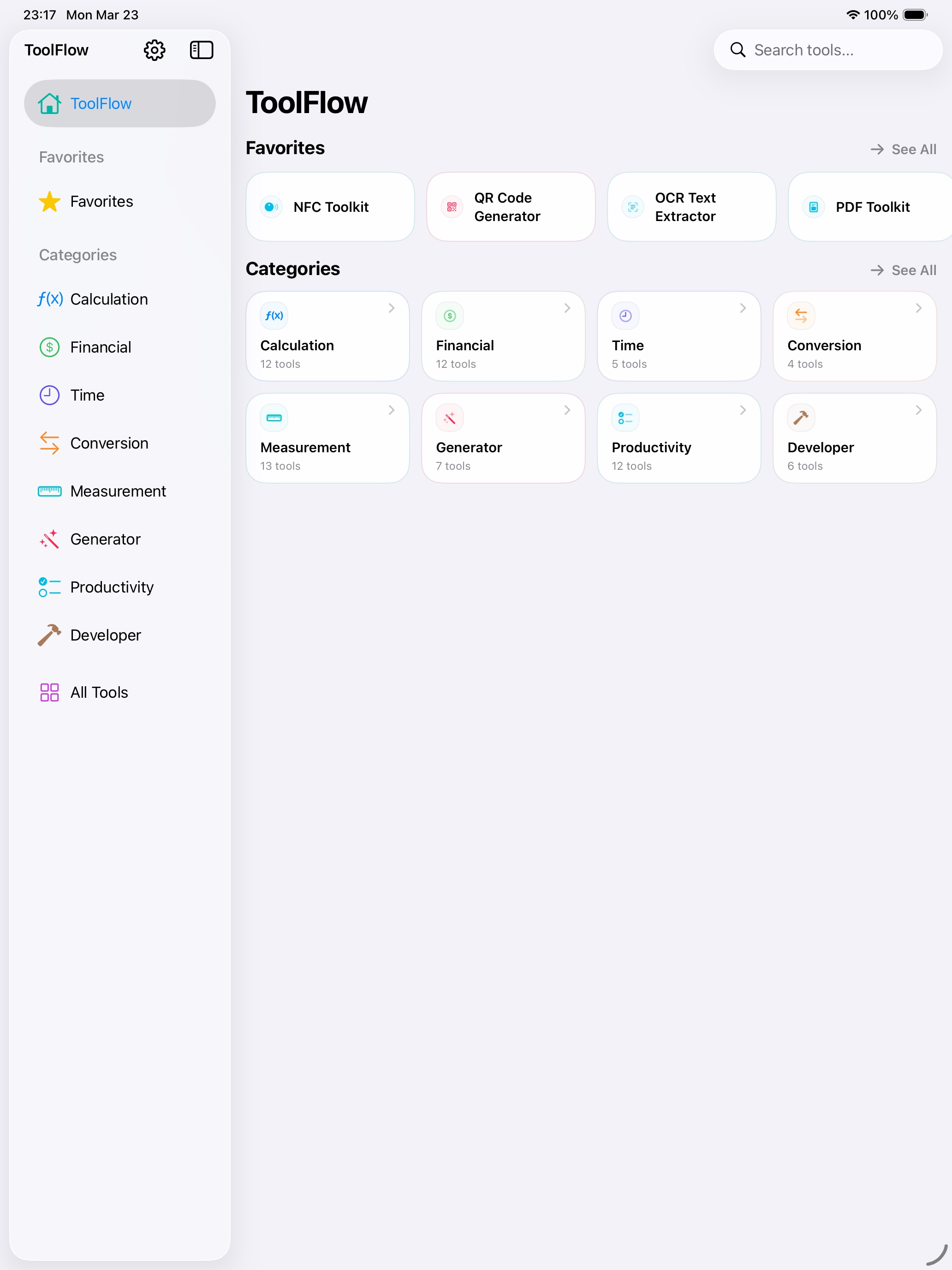
72 everyday tools for calculations, conversions, productivity, and more — built to work offline on iPhone and iPad.
A modular Swift architecture supports widgets, Spotlight, and system shortcuts. One agent-led improvement: adapting Fuel/EV unit selection to accessibility text sizes, with independent review and simulator checks.
View on the App Store (opens in a new tab)Visit ToolFlow website (opens in a new tab)
Decision. Keep familiar segmented controls at standard text sizes. For larger accessibility text, use a native menu with room for the title and selected unit to wrap.
Tradeoff. Larger text uses a menu instead of direct segmented selection. The whole title and value remain tappable, with readable labels and an adequate touch target.
Agent workflow. Agents reproduced clipping, tested alternatives, and independently reviewed the correction. Recorded simulator checks confirmed unit selection, retained choices after switching to EV mode, and complete English and Arabic labels.
Physical-device QA and final App Store submission remain my responsibility.
03 / WORK HISTORY
I've worked across enterprise SaaS, financial-services systems, and software engineering education.
Mar 2026 – Present
Software Engineer · Vault CRM
I work on Campaign Manager for Vault CRM, building scalable, fault-tolerant services and off-platform components for marketing automation. I also contribute to code reviews, engineer mentorship, and technical interviewing.
Agent KB · In progress. I'm also developing a local, review-gated knowledge base for my work at Veeva. It gives Claude Code scoped repository context, bounded search, and traceable sources between sessions.
May 2021 – Mar 2026
Software Engineer, then Senior Software Engineer
Promoted in November 2022.
I built and owned microservices and integration services for financial-services modernization. My work included file processing, configurable transformations, Kafka-driven file generation, and reactive services connecting legacy systems with REST APIs.
Selected contracts
2020 – 2026
Teaching Assistant · Computer Science
I supported computer science courses through lab sessions, assignment grading, and hands-on guidance, helping students develop programming and software engineering skills.
04 / SKILLS
The technologies and disciplines behind my work.
End-to-end SDLC design, agent orchestration, context engineering, tool integration, and independent review.
Responsive interfaces and deeper integration with the Apple ecosystem.
Repeatable checks and clear evidence that carry a native product through to release readiness.
Microservices, event-driven architecture, and reliable enterprise integrations.